The horse rug comes up every autumn in yard conversations: is it time to get it out already, and which one? Between turnout models, fleece liners and rain protection, it is easy to get lost. This article is not an exhaustive comparison of fabrics, but focuses on a very concrete question: when to rug your horse, and how to check day to day that the choice you made is the right one.
Horse rug: what is it really for?
A rug's only purpose is not to stop the horse from getting cold. It also serves to limit the energy spent on thermoregulation, to protect a clipped coat, to keep a horse dry in the rain, or to help it recover after exercise. A horse in the field, with a full winter coat and good body condition, regulates its temperature very well on its own, often better than with an unsuitable rug. Conversely, a clipped, old, thin or convalescent horse needs outside help as soon as temperatures drop.
Before asking which model to buy, it is therefore better to ask about each horse's real need, case by case.
When should you put a rug on your horse?
Temperature alone is not enough
There is no universal threshold valid for every horse. An unclipped horse, in good condition, living in the field, can stay rugless down to below-freezing temperatures if it has a shelter and a suitable ration. On the other hand, a clipped or cold-sensitive horse may need a rug as soon as the thermometer drops below 10 to 12 °C, especially in wind or fine rain that flattens the coat.
The criteria to weigh together are therefore:
- Whether or not the horse is clipped, and how extensively
- The horse's body condition (a thin horse has fewer reserves to keep warm)
- Age: older horses often regulate their temperature less well
- Wind and damp, which chill far more than still, dry air
- Lifestyle: access to a shelter, time spent outside, physical activity
Clipped, old or convalescent horses
These three profiles call for particular vigilance. A clipped horse loses the natural barrier that insulates its skin from the cold air: it will almost always need a rug from autumn onwards, adjusted by weight. An old horse or one in poor form deserves to be rugged a little earlier than others, even without clipping, as a precaution. Finally, a convalescent horse, which moves little, produces less heat on its own: the rug helps it avoid drawing on its reserves to keep warm. To track the day-to-day progress of these more fragile horses, our article on day-to-day horse health monitoring details the signs to watch.
How do I know if my horse is cold or too hot?
The ideal rug is not fixed: it is readjusted according to the day's weather. A few simple checks, to be done at every visit, help avoid the two excesses that are equally problematic: the horse that is cold under a rug that is too light, and the one that sweats under a rug that is too warm.
- The base of the ears and the neck: if they are cold to the touch, the horse probably needs an extra layer.
- The coat under the rug: if it is damp with sweat, the rug is too warm or poorly suited to the horse's activity.
- Behaviour: a horse that stays hunched up, back rounded, may be cold; a horse that frantically rubs its rug may be too hot or have an irritation.
- The state of the rug itself: a rug soaked through no longer protects from the cold, even if it seems to be in place.
These checks take a few seconds but deserve to be noted down somewhere, especially when several people look after the same horse. This is exactly the role of the shared log in GaloPlan: recording a rug change or an observation avoids omissions and duplicates between riders.
Which type of rug to choose for each situation
Once the need has been identified, it remains to choose the right type of rug. Each one meets a specific use, and many owners own several to adapt to the seasons.
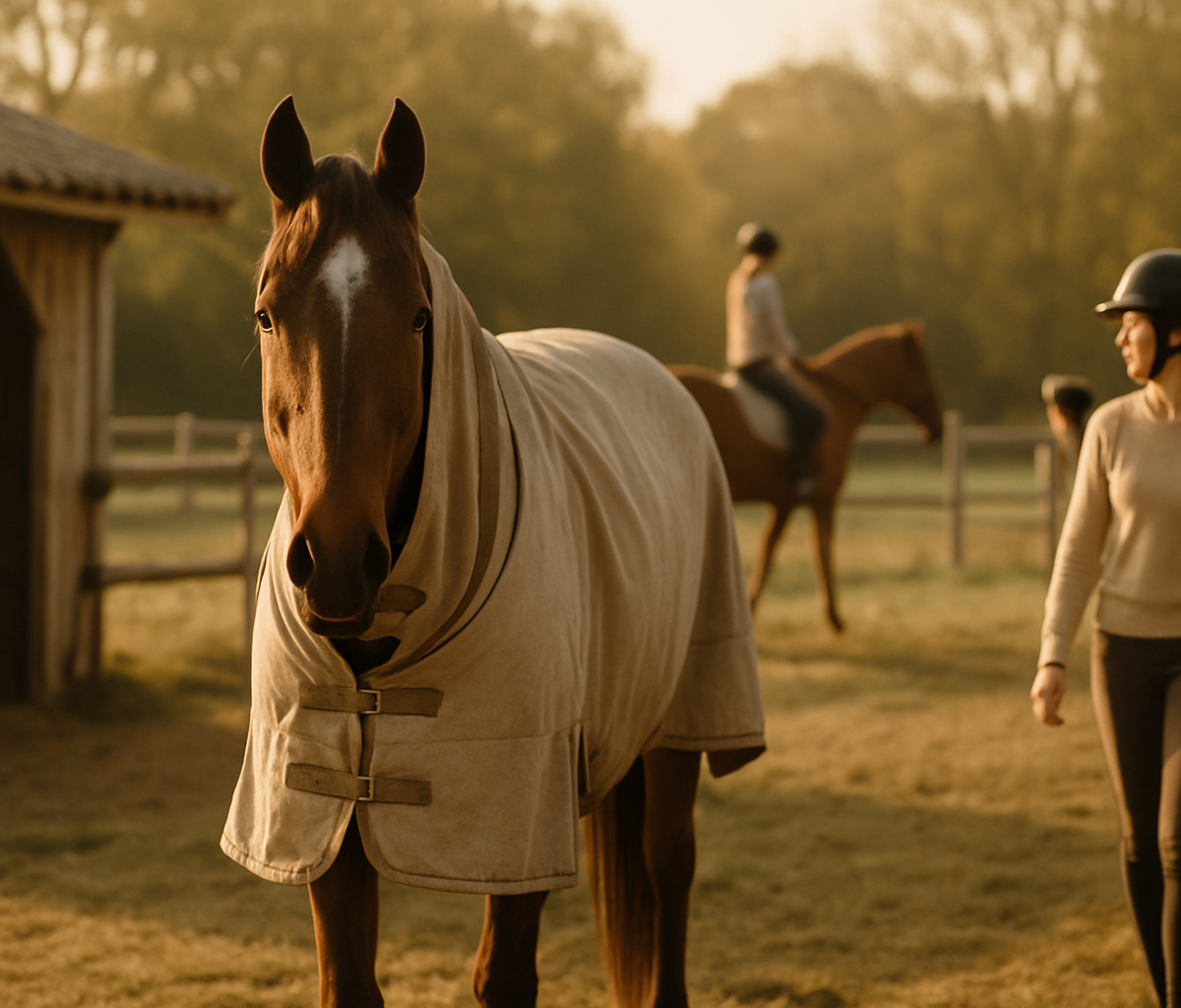
The turnout rug
Waterproof and breathable, it is the go-to for a horse living in the field. It is chosen by a weight expressed in grams of filling: the higher the figure, the warmer it keeps the horse. A model with no filling (known as a "rain sheet") only protects from rain and wind, without adding warmth.
The stable rug
Less water-resistant, it is designed for a horse in the box, where it mainly serves to limit heat loss at night or in cold, dry weather.
The fleece liner
It slips under a waterproof rug to add warmth without changing the main model. It is an economical and practical solution for adjusting protection from day to day, without multiplying full rugs.
| Type of rug | Main use | Situation |
|---|---|---|
| Rain sheet (no filling) | Rain/wind protection only | Horse in the field, mild damp weather |
| Light turnout (100-150g) | Moderate warmth + waterproofing | Autumn, unclipped horse |
| Warm turnout (200-300g) | Strong thermal protection | Winter, clipped or cold-sensitive horse |
| Stable rug | Warmth in the box | Cold night, horse brought in |
| Fleece liner | Extra warmth | Occasional adjustment to the weather |
Choosing the right size and cut
A poorly fitted rug rubs, injures the withers or shoulders, or lets the cold in. The size is measured in centimetres, from the base of the neck to the point of the buttock, and not according to the horse's weight. That said, knowing your horse's general build helps compare sizes between brands: our horse weight estimator can give a useful reference alongside a tape-measure reading. A good rug should never pull on the shoulders or hang too low at the back: these details prevent rubbing and recurring injuries.
Maintaining and tracking rug use day to day
A rug that truly protects is one that is maintained and checked regularly. It is better to establish a few simple reflexes rather than only remembering when a problem appears:
- Check every day that the rug has not slipped or rubbed during the night
- Remove the rug regularly to inspect the skin, especially at the withers and shoulders
- Adapt the weight to the weather forecast rather than to a fixed habit
- Clean and have straps or tears repaired before they get worse
These checks fit naturally into a well-built daily care routine. When several people work with the same horse, noting rug changes in a shared record avoids inconsistencies: a horse rugged twice by mistake, or one forgotten and left rugged on a mild day. Our article on the horse care record details what is worth recording through the seasons.
Common mistakes to avoid
Some habits come up often and deserve to be corrected. Rugging a horse "as a precaution" when it does not need it can weigh down its coat and make it sweat unnecessarily. Conversely, waiting too long before rugging a clipped or old horse wears it down silently, with no immediate dramatic sign. Finally, keeping the same rug from the start to the end of winter without ever adjusting it ignores the fact that the weather changes far faster than our habits.
The right approach remains regular observation: touch, look, adjust. A well-chosen horse rug is never fixed, it follows the variations in temperature and the horse's condition throughout the cold season. To go further on the feeding that also supports thermoregulation in winter, our article on feeding your horse in winter usefully rounds out this discussion.