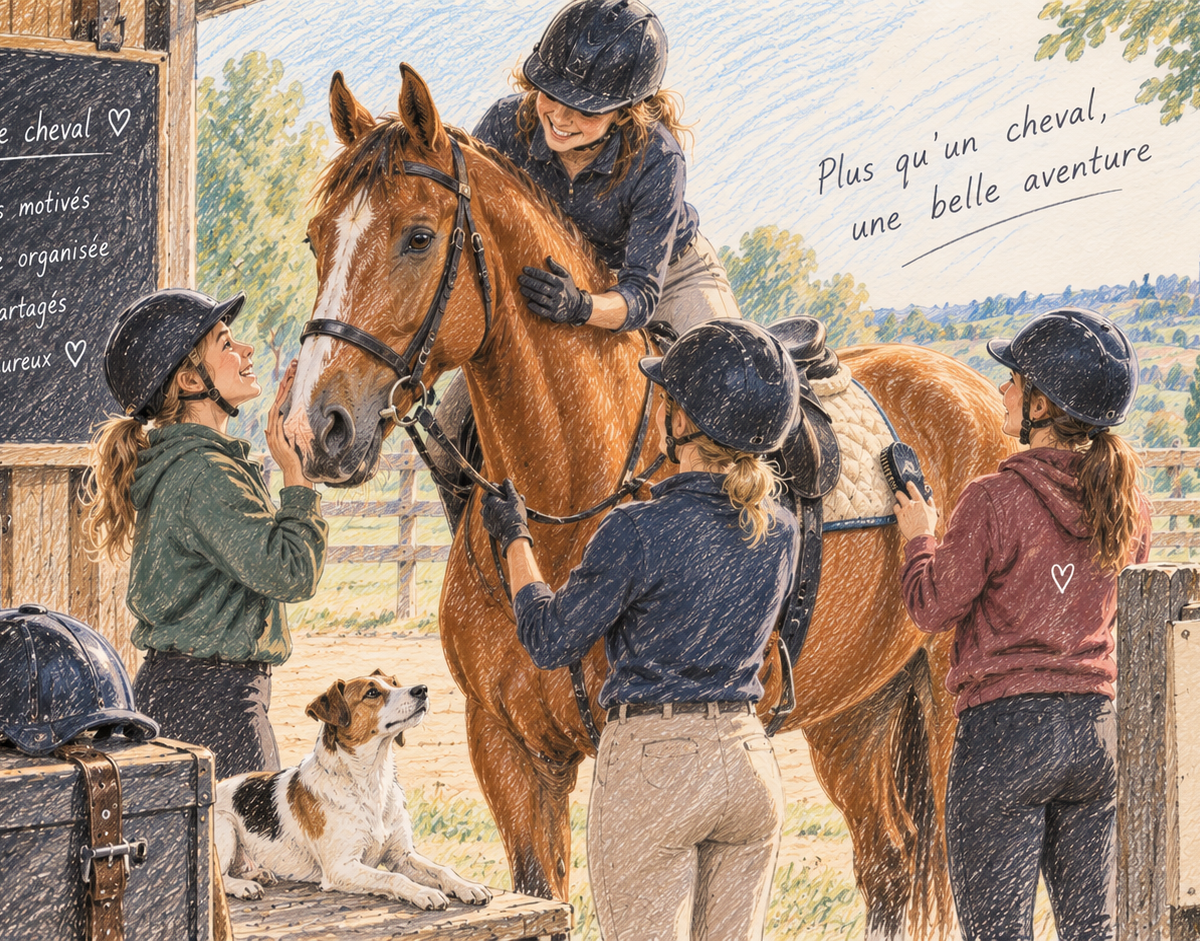
A horse ridden by several riders is a horse that gets more work, costs that are better shared and often a rewarding human adventure. It is also an organisation in its own right: here is how to structure it so that sharing stays a pleasure.
The different ways to share a horse
Sharing a horse takes many forms: the classic share-board (an outside rider in exchange for a financial contribution), the part-loan (one or two days a week), the family horse ridden by parents and children, sharing between stable friends, or the horse followed by a coach who works it on certain days.
Each arrangement has its own rules, but they all share the same needs: clear roles, an organised week and information that flows.
Defining everyone's role
Who decides on care? Who can take the horse to a competition? Who has a say and who simply has the right to ride? These questions deserve an explicit answer before the first misunderstanding.
In GaloPlan, each team member has a defined role (owner, rider or read-only) that reflects this reality: everyone sees the same thing, but each person acts according to their place.
Organising the riding week
The basis of a smooth sharing arrangement is a typical week: each rider has their days, the horse has its rest, and the exceptions (swapped days, competitions, absences) are written down rather than assumed.
That is the role of the shared planner: the weekly routine is visible to everyone, one-off exceptions stay recorded, and the horse's appointments (farrier, vet) appear among the riding days, because care tracking is part of sharing.
Keeping information flowing
The real risk of sharing is not conflict, it is silence: the stiff horse no one mentions, the intense session followed by another intense session, the supplement started without telling anyone.
Two tools solve the problem: a shared journal where every session and every care event is recorded, and a team chat for day-to-day exchanges, photos and videos included. Everyone can also find their riding days in their own calendar thanks to calendar sync.