Tracking your horse's feed ration day after day is nothing automatic, especially when several people look after the same horse. Between the hay, the concentrates, the supplements and the water, it is easy to lose track without a minimum of organisation. At the GaloPlan team, we see every day how much a simple, regular record makes a difference to a horse's health and comfort.
Why tracking your horse's feed ration daily changes everything
A horse eats several times a day, often fed by different people depending on the time slots: owner, share-boarders, groom, instructor. Without traceability, you never really know what was given in the morning, whether the supplement was forgotten, or whether the amount of hay was increased the day before without everyone knowing. This vagueness may seem harmless, but it exposes you to dosing errors, missed supplements and even double feedings.
Tracking the ration daily also means you spot warning signs more quickly: a horse that leaves its hay, drinks less or refuses its pellets. These changes in feeding behaviour are often the first clues of a digestive problem or emerging pain. In that respect, knowing how to recognise the signs of colic often starts with careful observation of the appetite.
The basics of a balanced ration
Before talking about tracking, it is worth recalling the main principles of balanced feeding. Every horse is different depending on its age, build, workload and physiology, but a few benchmarks remain valid for most riding-school or privately owned horses.
Forage, the foundation of everything
Hay or grass should make up the largest part of the ration, fed if possible in several meals to respect the natural working of the horse's digestive system. Too limited access to forage encourages boredom, stereotypies and increases the risk of digestive disorders.
Concentrates, to be adjusted carefully
Pellets or cereals supplement the energy intake according to the work done. A horse at rest or in light work rarely needs a large amount of concentrates; conversely, a horse in full show preparation may require higher intakes. To fine-tune these calculations, our guide to calculating the ration details the right proportions between hay and concentrates.
Water and supplements
Clean water available at all times is a pillar of feed management that is too often overlooked. As for supplements (minerals, vitamins, joint support), they must be given regularly, because their effectiveness relies precisely on consistency.
Adapting the ration to the horse's weight and condition
A well-planned ration always starts from a reliable estimate of the horse's weight. Without scales to hand, there are simple methods to get close to it, as explained in our article dedicated to estimating weight without scales. This figure is the basis for all ration calculations and helps avoid both underfeeding and excess.
It is also useful to monitor the horse's body condition regularly: the line of the back, the visibility of the ribs, the roundness of the hindquarters. These observations, noted over time, help you gradually adjust the amounts rather than reacting too late to a marked weight gain or loss.
| Factor | Effect on the ration |
|---|---|
| Workload | The more intense the work, the more the energy needs increase |
| Season | Winter often calls for more forage for thermoregulation |
| Horse's age | Young horses and seniors have specific nutritional needs |
| State of health | Some conditions require precise adjustments, to be confirmed with the vet |
Setting up a simple daily record
The hardest part is not knowing the right proportions, but applying them consistently, especially when several people are involved. A paper notebook hung on the stable door may be enough for a horse managed by one person, but as soon as a team shares the meals, forgetfulness and misunderstandings become common.
An effective record relies on a few simple habits:
- Note each feeding: amount of hay, type and amount of concentrates, supplements given.
- Record ration changes as soon as they are decided, with the start date.
- Report any refusal to eat or unusual behaviour at mealtime.
- Regularly check stock levels to anticipate orders.
This is exactly what a well-kept care record allows: centralising the information so everyone knows what has been done, without having to ask or guess.
Communicating well when several people feed the horse
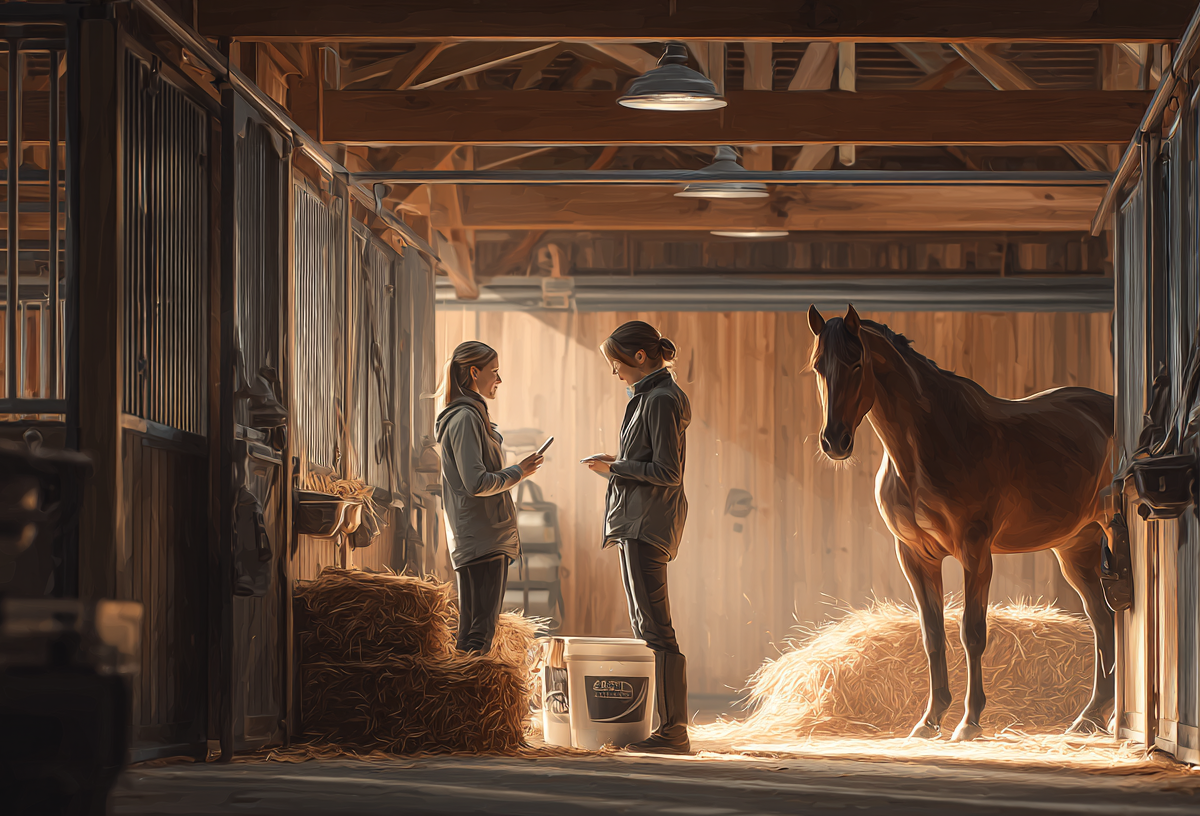
As soon as a horse is in shared livery, at a riding school or managed by several share-boarders, communication becomes as important as the ration itself. An instruction given verbally one morning may never reach the person feeding in the evening. To avoid these losses of information, it helps to centralise exchanges in a shared space, accessible to everyone involved.
Our article on organising a team around a horse details practical methods to smooth these exchanges, whether for meals, care or the work schedule. The idea is not to multiply tools, but to have a single place where everyone can view and update the essential information.
An app like GaloPlan, designed for the shared management of a horse's daily life, lets you bring the feeding log, the reminders and the team messaging together in one place. You can explore all of these features to see how they fit your situation.
Avoiding common tracking mistakes
Some mistakes come up often, even among experienced riders:
- Changing a ration abruptly without a gradual transition, which can upset digestion.
- Relying solely on memory rather than a written or digital record.
- Forgetting to report a change in appetite, thinking it is "no big deal".
- Not adjusting the ration after a period of forced rest, for example following an injury.
These small lapses, taken in isolation, often seem inconsequential. But when they add up, they can lead to gradual dietary imbalances that are harder to correct once established. That is why a regular record, even a brief one, is always preferable to no traceability at all.
Making feeding a team reflex
Tracking your horse's feed ration day to day should not be seen as an administrative chore, but as a tool for collective peace of mind. When everyone knows what has been given, what remains to be done and what to watch for, meals become a simple moment rather than a source of constant doubt.
To go further in the overall organisation of your horse's daily life, you can also check out our free tools, useful for refining your ration calculations alongside a regular record.