Setting up regular daily horse care is not one more chore: on the contrary, it is what makes everyday life simpler. A well-thought-out routine lets you quickly spot a health issue, keep a horse clean and comfortable, and forget nothing even when several people look after it. In this article, we offer a simple framework to adapt to your schedule, your type of livery and your horse's needs.
Why a daily horse care routine changes everything
A horse is a creature of habit. It quickly picks up on the rituals that shape its day, and this regularity reassures it as much as it makes your organisation easier. In practical terms, a clear routine prevents oversights: a poorly picked-out hoof, an unchecked bucket or a sign of lameness that goes unnoticed because no one took the time to observe the horse calmly.
It is also an excellent prevention tool. By repeating the same actions every day, you develop a trained eye that immediately detects anything out of the ordinary: unusual heat, a wound, a change in behaviour. To go further on this topic, our article on the essential actions for your horse's daily health details the warning points you should not overlook.
The morning: the essential steps to start the day well
The morning routine sets the tone for the day. It can be summed up in a few simple steps, to be carried out calmly:
- Check the horse's general condition: is it standing and alert, eating normally, behaving as usual?
- Check the bedding and the droppings: their appearance and quantity give valuable clues about transit and appetite.
- Give the hay and concentrates according to the planned ration, taking care to keep to the usual times.
- Refresh the water if it is not already freely available, clean and at a suitable temperature.
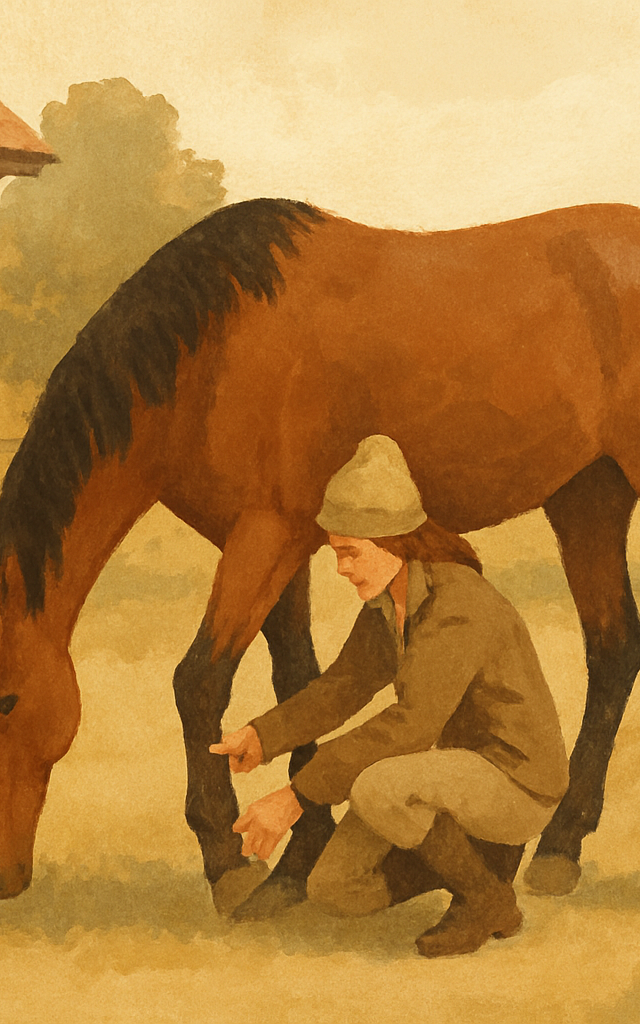
- A first look at the legs to spot heat, swelling or a wound.
These checks take only a few minutes, but they allow you to act quickly if there is a problem, even before work begins.
Grooming and observation: the ritual that reveals a lot
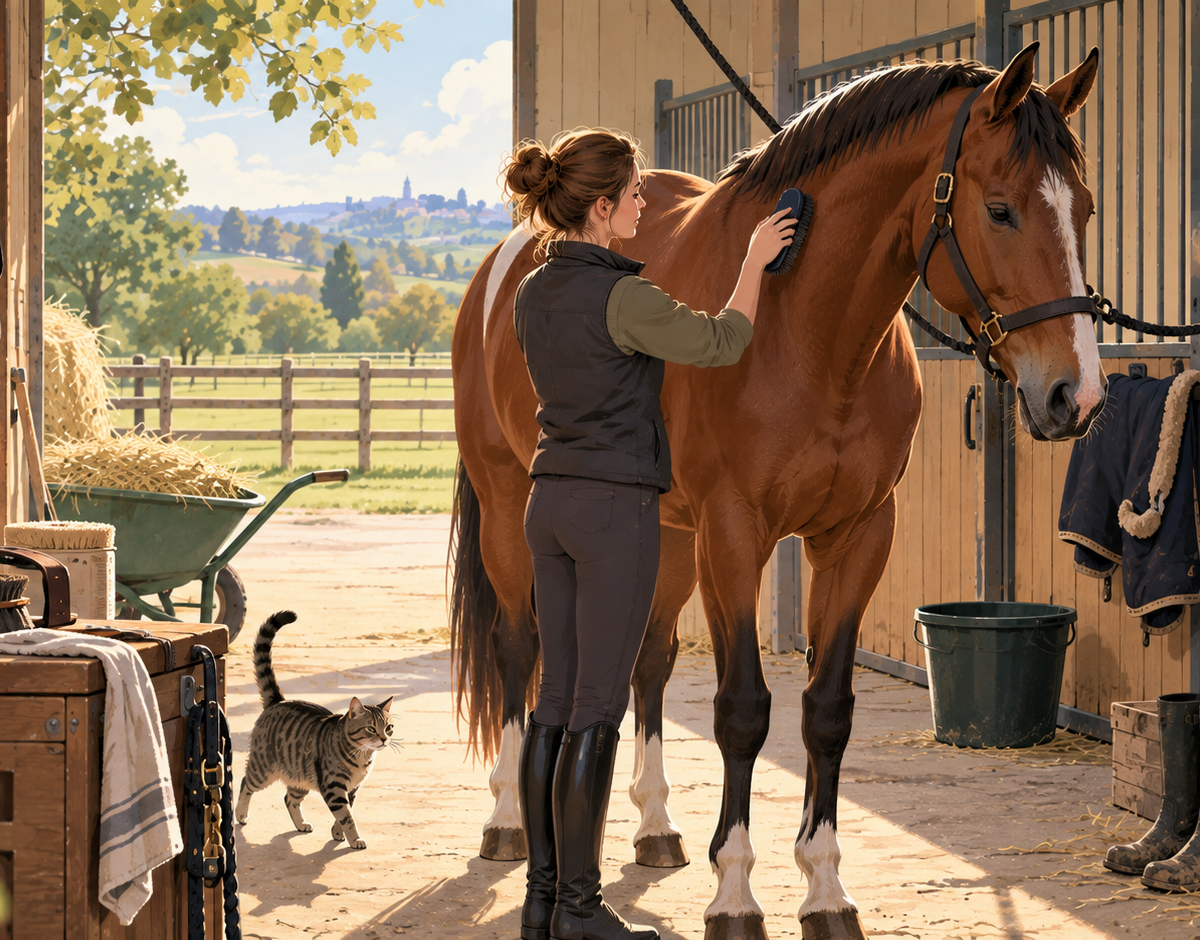
Grooming is not just about appearance: it is a moment of close observation that is an integral part of daily horse care. By running your hands and brushes over the whole body, you more easily spot a sensitive spot, a small wound hidden under the coat or the start of inflammation.
Take the chance to systematically inspect:
- The feet: stones, a suspicious smell, the state of the frog.
- The eyes and nostrils: no abnormal discharge.
- The skin: no scabs, mud fever or bald patches.
- The gaits at the walk in hand, if you suspect lameness.
This grooming ritual, repeated every day, also creates a real moment of closeness with the horse, which is never to be dismissed in the relationship of trust you are building with it.
Feeding, the cornerstone of the daily routine
Feeding your horse properly is probably the most visible aspect of daily care. It means keeping to regular times, adapting the amounts to the activity and the season, and watching that nothing is left in the manger in an unusual way.
If you are unsure about the proportions of hay and concentrates to give, our article calculating your horse's ration offers a simple method, and our free ration calculator tool can help you fine-tune your intakes according to the horse's weight and work. In winter, needs also change: our article on feeding your horse in winter guides you in adapting the ration to the cold.
The evening: rounding off the day nicely
The evening routine lets you close the day calmly and prepare for the next one:
- A final meal or extra hay depending on the stable's habits.
- A quick check of the horse's condition, especially if it has worked during the day.
- Picking out the feet to remove accumulated residue.
- Checking access to water and the state of the bedding for the night.
- A final look at the field or stable to make sure no dangerous objects are lying around.
This moment is also the chance to note anything that needs following up: a slight heat observed, a change in appetite, or simply the fact that all is well.
Adapting the routine to the type of livery
The care routine will not be the same depending on whether the horse lives at grass, in a stable or at an active stable yard. A horse at grass calls for particular vigilance about the state of the fencing, access to shelter and the quality of the grass, while a stabled horse needs more frequent mucking out and greater attention to boredom, which can encourage certain unwanted behaviours. If you are still unsure which type of livery suits your horse best, our article choosing your horse's livery: grass, stable or active yard will help you take stock.
Recording your daily horse care so you forget nothing
An effective routine also relies on memory... or rather on not having to remember everything in your head. Noting down each day what has been done and observed keeps a clear view of the horse's progress, especially when several people look after it: owner, share-boarders, groom or riding-school riders.
That is exactly the role of a well-kept care record. Our article horse care record: what to really write down details the essential information to record, while the horse logbook explains why this simple habit makes all the difference day to day.
It is precisely to make this tracking easier that we designed GaloPlan: a shared space where everyone who looks after the horse can check the schedule, add an observation, flag a vet or farrier appointment, and find the full history of care. Discover all the features of GaloPlan to see how the app can fit into your daily routine, on your own or as a team.