
Keeping a horse care record up to date means giving your companion reliable tracking over time, even when several people look after it. Between vaccinations, farrier visits, minor ailments and changes in feeding, it is easy to lose track. A well-kept record then becomes a real tool of collective memory, useful to the owner and to the vet when needed.
In this article, we offer a practical overview of what is worth noting, why it really matters, and how to organise this information without it becoming a daily chore.
Why keep a care record for your horse?
A horse often passes through several hands: owner, share-boarders, riding-school riders, grooms, instructors. Without a written record, everyone keeps their own memories, sometimes vague or contradictory. The horse care record centralises this information so that everyone has access to the same truth.
In practical terms, it is used to:
- Avoid missing vaccination boosters or worming doses
- Spot a change in behaviour or a recurring discomfort more quickly
- Give precise, dated information to the vet or the farrier
- Ensure continuity of tracking if the stable or owner changes
It is also a source of peace of mind: you no longer have to rely solely on your memory or on messages scattered across several apps.
The essential medical information to record
The heart of the care record concerns the horse's health, of course. Here are the items worth noting systematically, with the exact date:
Vaccinations and worming
Each vaccine injection should be noted with its date and the type of vaccine given, so you can anticipate the next booster without last-minute stress. The same goes for worming: recording the date and the active ingredient used helps you follow a consistent worming plan over time.
Veterinary visits
Every visit from the vet, whether a routine check, a dental check or a consultation for a one-off problem, is worth noting with the reason, the observations made and any recommendations given. These notes become valuable if a similar problem reappears later.
Injuries, wounds and related care
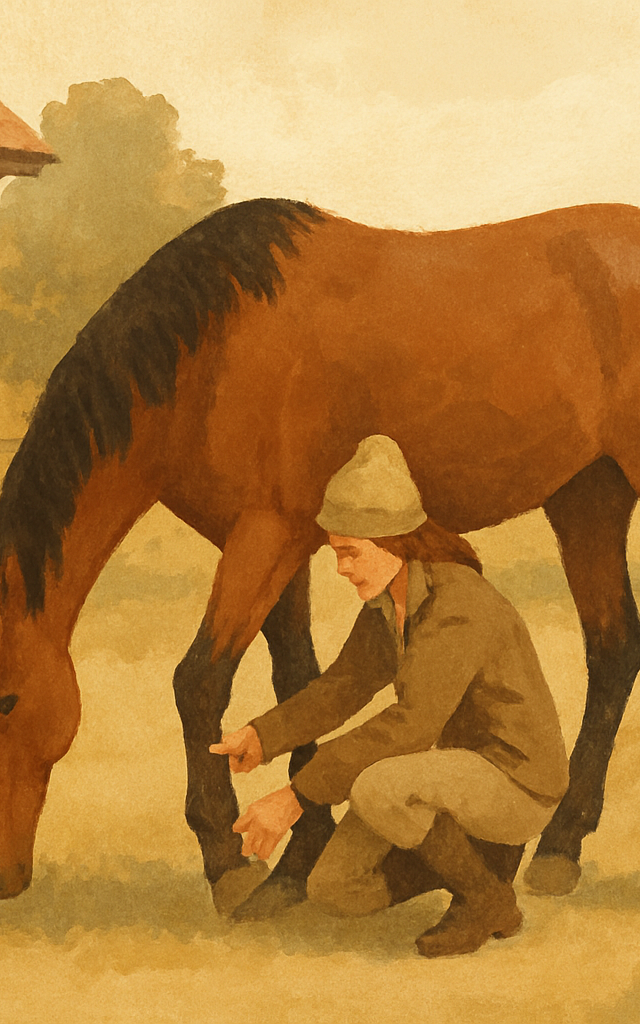
A small wound, a sprain, a foot abscess: each incident deserves its line in the record, with a description of the injury, the treatment applied and its progress day by day. This lets you check that healing is following a normal pace and raise the alarm quickly if it is not.
Farrier visits
Trimming or shoeing dates, remarks on the state of the feet, any adjustments: this information helps you keep an eye on how regular the visits are and spot any recurring problems with the horse's stance or hooves.
Daily tracking: feeding, behaviour, training
Beyond one-off care, a complete record benefits from including more everyday observations, which often reveal small changes before they become more serious problems.
- Feeding: ration changes, new supplements, reactions observed after a change
- Behaviour: signs of unusual nervousness, loss of appetite, reluctance to work
- Training: type of work done, duration, difficulties encountered, progress over time
- Passing lameness or stiffness, even slight, that is worth monitoring
These notes, taken regularly, let you cross-reference information and better understand the origin of a problem when it appears. For example, discomfort at work can sometimes be linked to a change in feeding that happened a few days earlier.
How to organise your care record effectively
A care record is only useful if it is simple to keep and easy to consult. Here are a few principles that make the difference:
- Always date each entry, even the most trivial ones
- Use clear categories (health, feeding, training, shoeing) to find information quickly
- Stay concise but precise: a short, factual sentence is better than a vague paragraph
- Centralise the information in one place, rather than scattering it across several notebooks or messages
When several people look after the horse, this centralisation becomes even more important. That is precisely what a tool like GaloPlan allows, bringing the care log, the riders' schedule and the vet or farrier reminders together in one shared space.
Paper record or digital record?
The paper record was long the default solution, and it keeps its charm: it is easy to write in and slips into your kit bag. But it quickly shows its limits as soon as several people are involved with the same horse: risk of loss, information not shared in real time, difficulty finding a specific event among handwritten pages.
A shared digital record naturally solves these limits. Everyone can check the history from their phone, add an observation right after a session, and receive an alert before a vaccination or worming booster. The features designed for the shared management of a horse's daily life let you combine the care log, team messaging and reminders in one place, without having to juggle several tools.
If you want to go further in setting up structured tracking, our guides explain step by step how to organise the riders' schedule alongside the care record, for consistent management from A to Z.
A few good habits to adopt
For the care record to truly come alive day to day, here are a few simple reflexes to establish with the whole team around the horse:
- Note an observation right after the care or the session, while the details are still fresh
- Review the history regularly to spot trends (frequency of abscesses, regularity of visits, etc.)
- Systematically share important information with the other people involved, rather than keeping it to yourself
- Set up automatic reminders for recurring deadlines, so you no longer depend solely on memory
Once established, these habits take very little time day to day, while bringing real peace of mind in the long run.
A well-kept care record never replaces the vet's eye, but it gives them precise reference points to better understand the horse's history.