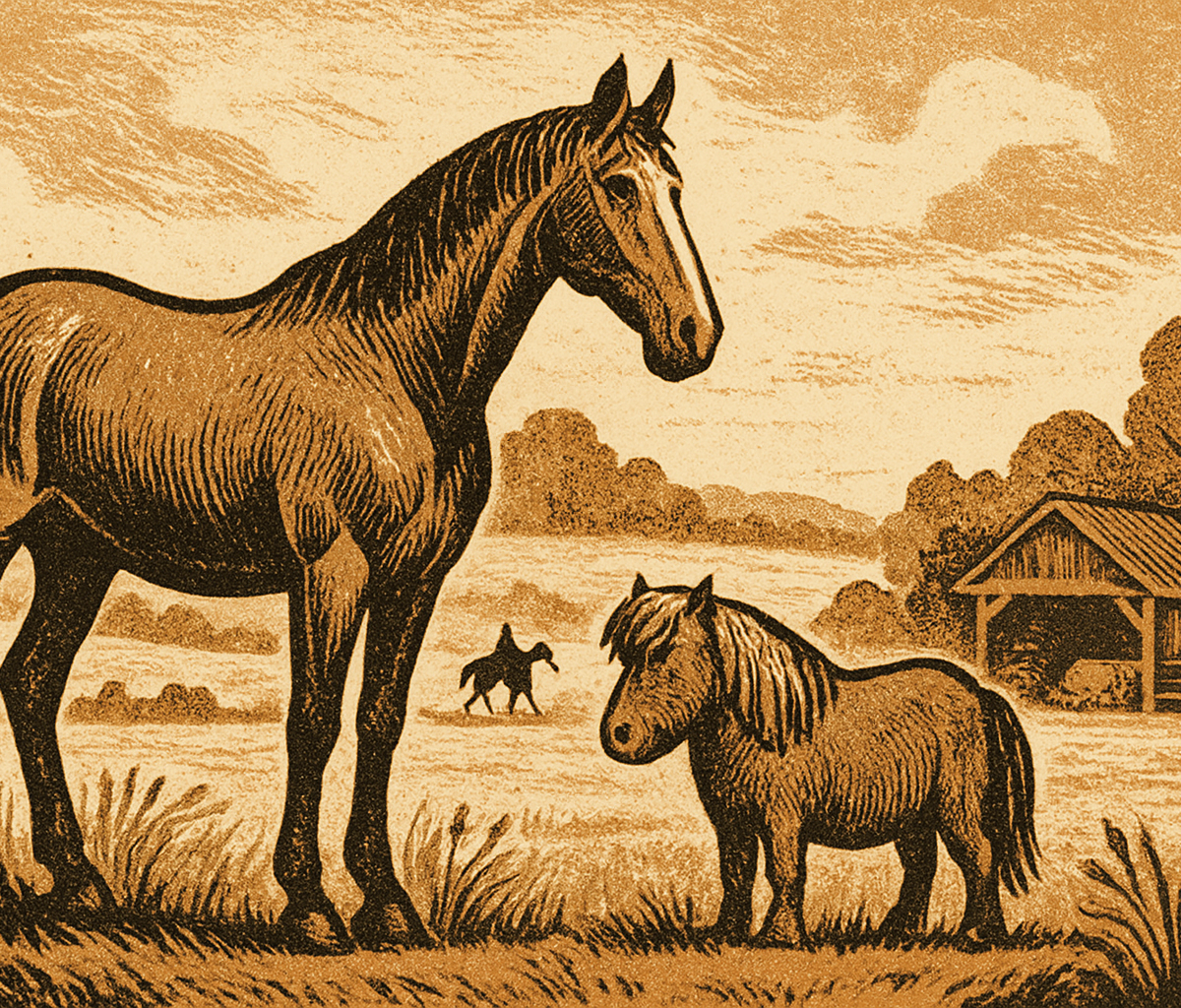
An adult riding horse weighs on average between 450 and 600 kg. But behind this average lie enormous differences: a Shetland pony barely weighs 180 kg while a draught horse easily tops a tonne. Here are the weight benchmarks by breed and type, how to estimate your own horse's weight, and why this figure matters day to day.
How much does a horse weigh?
It all depends on its size and type. The orders of magnitude to remember:
- Pony: from 150 to 500 kg depending on the category (from the Shetland to the large pony);
- Riding horse: from 400 to 600 kg for most riding-school and sport horses;
- Draught horse: from 700 to over 1,000 kg for the biggest.
For a given height, weight also varies with bone, muscle, body condition and season: the same horse can gain or lose 30 to 50 kg between spring grass and the end of winter.
Average horse weight by breed and type
The ranges below are for adult animals in normal body condition. They are indicative benchmarks: any individual may fall outside them.
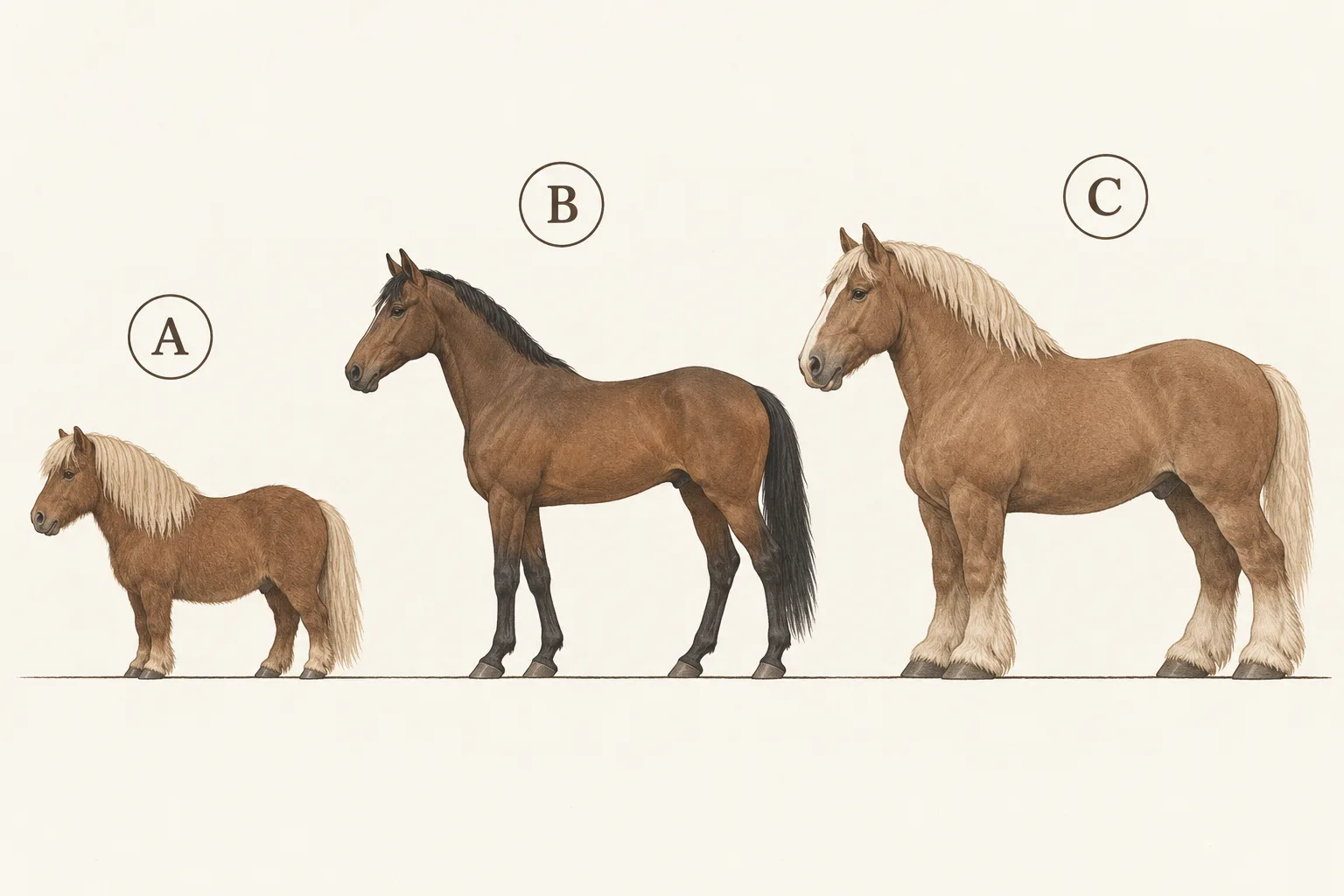
At the same scale: A, Shetland pony (150 to 200 kg); B, riding horse (500 to 600 kg); C, draught horse (800 kg and over).
| Breed or type | Height at the withers | Average weight |
|---|---|---|
| Shetland pony | 0.90 to 1.07 m | 150 to 200 kg |
| Pony (cat. B/C, Welsh type) | 1.10 to 1.40 m | 200 to 350 kg |
| Large pony (cat. D) | 1.40 to 1.48 m | 350 to 500 kg |
| Camargue | 1.35 to 1.50 m | 350 to 500 kg |
| Arabian | 1.45 to 1.55 m | 400 to 450 kg |
| Thoroughbred | 1.55 to 1.70 m | 450 to 550 kg |
| Selle Français and sport horses | 1.60 to 1.75 m | 500 to 600 kg |
| Friesian | 1.55 to 1.70 m | 550 to 700 kg |
| Breton and Comtois draught | 1.55 to 1.65 m | 700 to 900 kg |
| Percheron, Trait du Nord, Shire | 1.65 to 1.85 m | 800 to 1,000 kg and over |
The known record is still Sampson, a 19th-century English Shire, estimated at around 1,500 kg.
What about the foal?
At birth, a foal weighs about 10% of the adult weight of its breed: around 45 to 60 kg for a riding horse, 20 kg for a Shetland, up to 80 kg for a draught horse. Growth is then very rapid: by around 12 months, a foal already reaches about 60 to 65% of its adult weight, and most growth is complete by around 3 years.
How can you find out your horse's weight without a scale?
Few yards are equipped with a weighbridge. The reference method uses a simple tape measure and a scientifically validated weight formula (Carroll & Huntington, 1988):
Weight (kg) = heart girth² × body length ÷ 11,877
You measure the girth at the girth groove and the length from the point of the shoulder to the point of the buttock. The result is accurate to within 5 to 10%, more than enough to adjust a ration or dose a wormer.
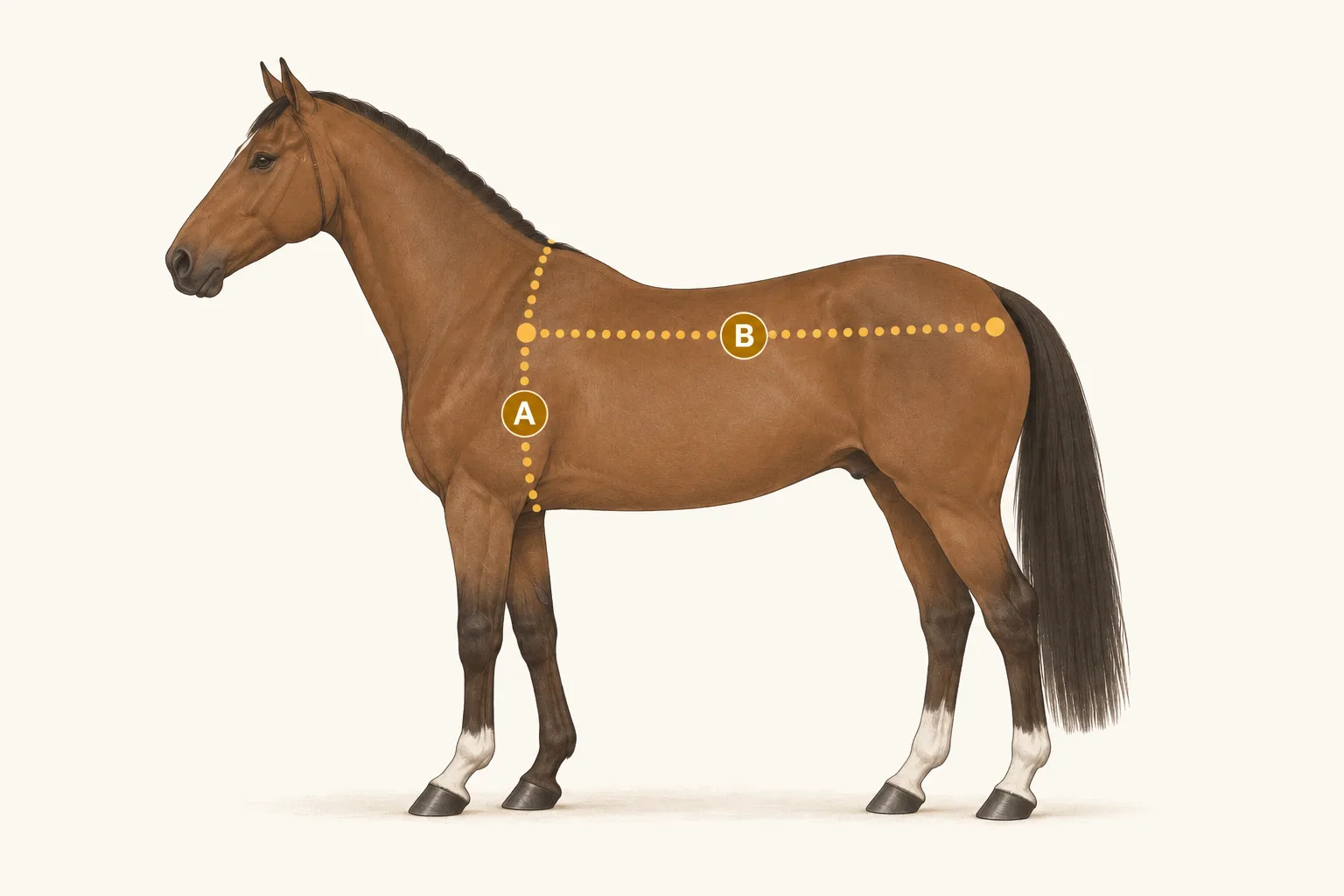
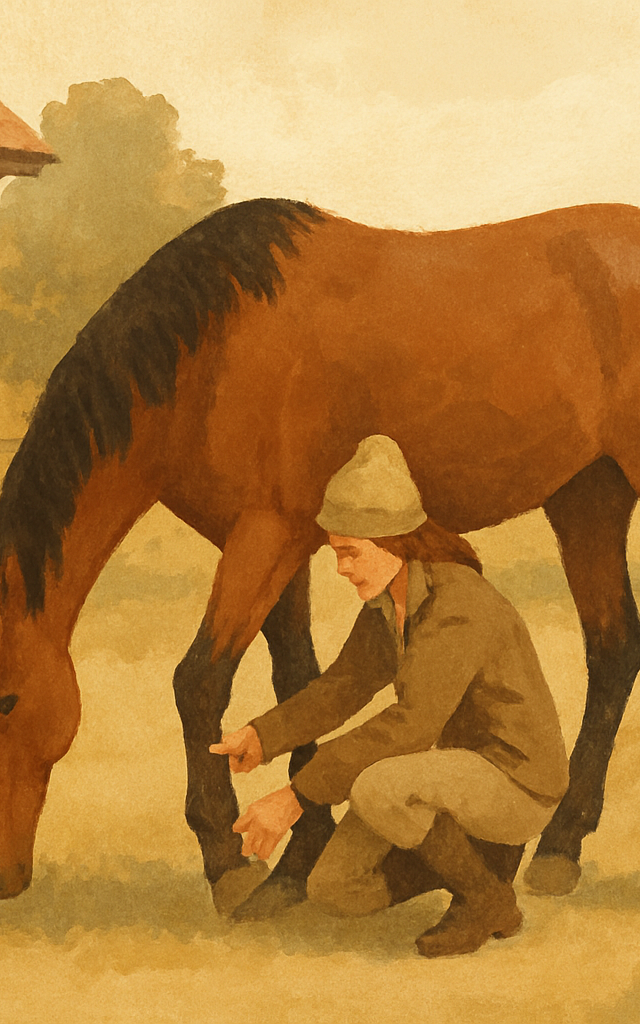
The two measurements in the weight formula: A, heart girth (around the chest at the girth groove, just behind the withers); B, body length (from the point of the shoulder to the point of the buttock).
To skip the calculation, use our free horse weight estimator: you enter your two measurements, and it does the rest.
Ideal weight: beyond the figure, body condition
A "good" weight cannot be judged on its own: two 500 kg horses can be, one too thin, the other too fat. Vets use the body condition score (from 0 to 5 in France): you look at and feel the fat cover over the neck, withers, ribs, back and tailhead. A simple benchmark: the ribs should not be visible, but should be felt easily under the fingers.
A rapid change in weight, in either direction, is a warning sign: teeth, parasites, an unsuitable ration, a metabolic disease and more. This is why regular monitoring matters more than an isolated measurement.
How much weight can a horse carry?
Studies recommend that a horse carry no more than 15 to 20% of its own weight, rider and equipment included. For a 500 kg riding horse, that comes to 75 to 100 kg in total. The horse's conformation (a short, strong back, bone), its fitness and the rider's balance count as much as the raw figure.
Why monitor your horse's weight?
- Adjusting the ration: the amounts of hay and hard feed are calculated from the weight, see our ration calculator;
- Dosing wormers and medication: most doses are prescribed by weight;
- Detecting a health problem early: a loss of condition shows on a chart well before it becomes obvious at the stable.
Ideally, measure once a month, always the same way, and record the result. In GaloPlan, each horse's Health space lets you record weigh-ins and track the weight chart as a team, with the shared care record for everything else in daily life.