For a long time, horses were wormed "blind", on fixed dates, several times a year. Today, vets recommend a more refined approach: targeted worming. The principle: treat at the right time, with the right product, based on tests, to protect the horse effectively while preventing parasites from becoming resistant to wormers. Here is how to choose the right wormer for your horse and how often to use it.
Why stop worming blind?
Worming every horse systematically, all the time, has a perverse effect: parasites end up getting used to the active ingredients, which lose their effectiveness. This is known as resistance. Since very few new active ingredients are being developed, it is essential to preserve those that exist. Targeted worming therefore means treating only when it is useful, focusing on the right animals and the right parasites.
The central role of the faecal egg count
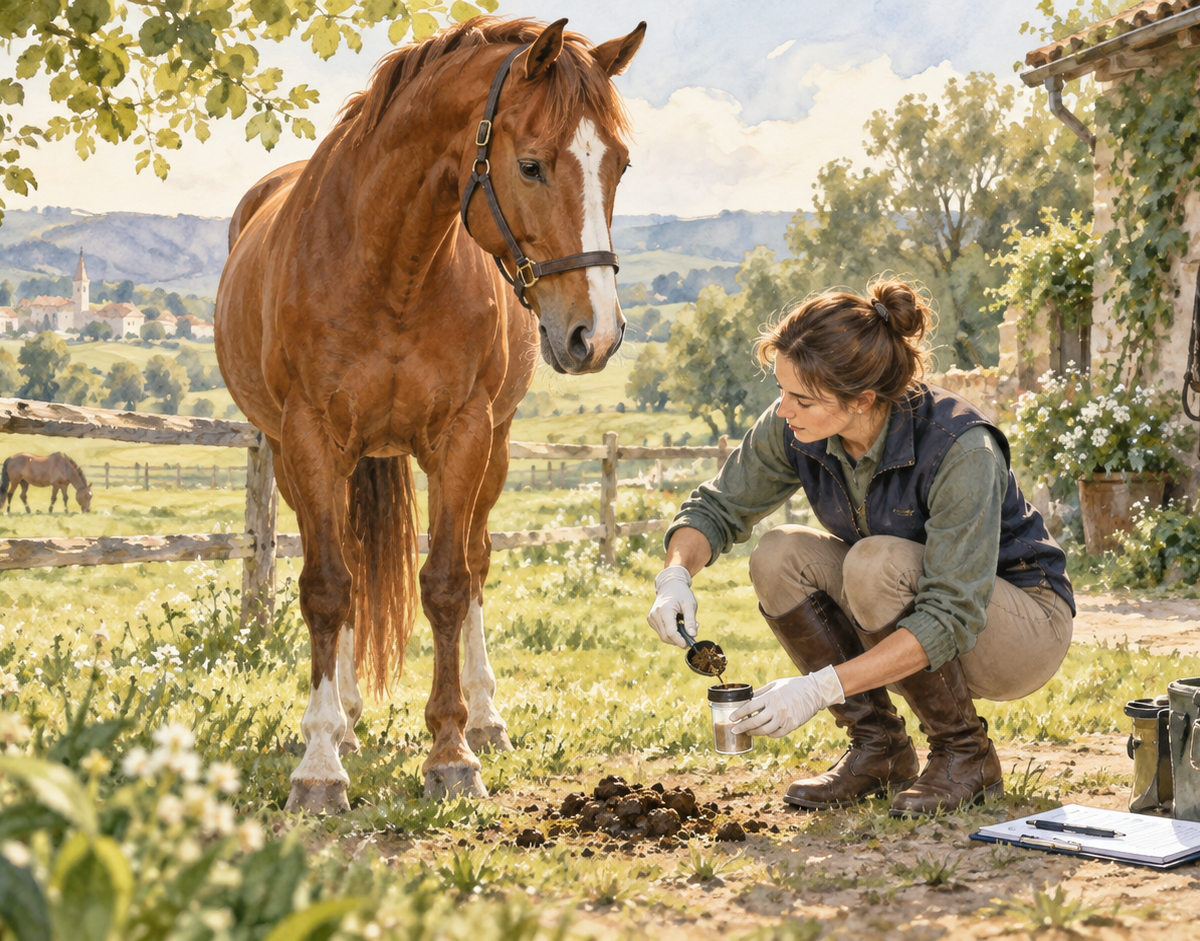
The faecal egg count (coproscopy) is a microscope analysis of droppings that counts parasite eggs. In the adult horse, treatment is generally considered justified above 200 eggs per gram of droppings. In plain terms: you take a sample, analyse it, and only worm if the result justifies it. Some horses shed a lot of eggs, others very few: this approach avoids needlessly treating those that do not need it.
Be careful, though: two important parasites do not show up on the faecal egg count, tapeworms (flat worms) and bots (fly larvae). For these, you cannot rely on the analysis: you treat them specifically at certain times of the year.
The seasonal worming calendar
For an adult horse living out, two to four treatments a year are generally used, spread across the seasons:
- February to March: small strongyles, as selective treatment after a faecal egg count.
- June to July: small and large strongyles, for all horses at grass.
- August to September: small strongyles, possibly tapeworms, depending on the faecal egg count result.
- November to December: strongyles, but also tapeworms and bots, for all horses. This is the "end of year" treatment that covers the parasites invisible to the analysis.
You can find this calendar, ready to use, in our free vaccination and worming calendar, alongside our other tools for owners.
Which active ingredients for which parasites?
Without going into the detail of brands, remember that the main families of wormers do not all cover the same parasites. Ivermectin and moxidectin act on strongyles; praziquantel is the reference ingredient against tapeworms. This is why the end of year treatment often combines a "complete" product. The precise choice is made with your vet, based on faecal egg counts and how the horse is kept.
The case of young horses
Foals and young horses (1 to 3 years old) are more susceptible to parasites. For them, worming is more frequent and often systematic, at a rate of three to four treatments a year. The faecal egg count is still useful for monitoring, but the tolerance threshold is lower.
Recording every wormer carefully
As with vaccinations, the point is to keep a record: which product, which date, which horse. When several people look after the same horse, a wormer can quickly be given twice, or forgotten. With GaloPlan, every treatment is logged in a shared care record, and you always know what to note down for reliable tracking.